MTB Frame Bag: Snug, Silent Storage For Rough Trails
Mountain biking punishes loose gear. Bar bags swing, backpacks make your shoulders sweat, and a rear pack throws weight behind your rear axle exactly where you don't want it on a steep descent. A frame bag built for the trail fixes all three problems at once — and the Ridgeline Trail is our answer.
Pick your bag
🚨 Only a few left in stock
Free shipping · 30-day money-back guarantee · Secure checkout
Why a frame bag beats a backpack on the trail
Ask any rider who has bombed a rocky descent with a loaded pack on their shoulders: the weight wants to keep going when you don't. A backpack raises your center of gravity and shifts around as you move, which is the last thing you want when the front wheel is dancing over roots. A rear rack or seat pack pushes mass behind the rear axle, making the bike feel tail-heavy and vague on steep, loose terrain.
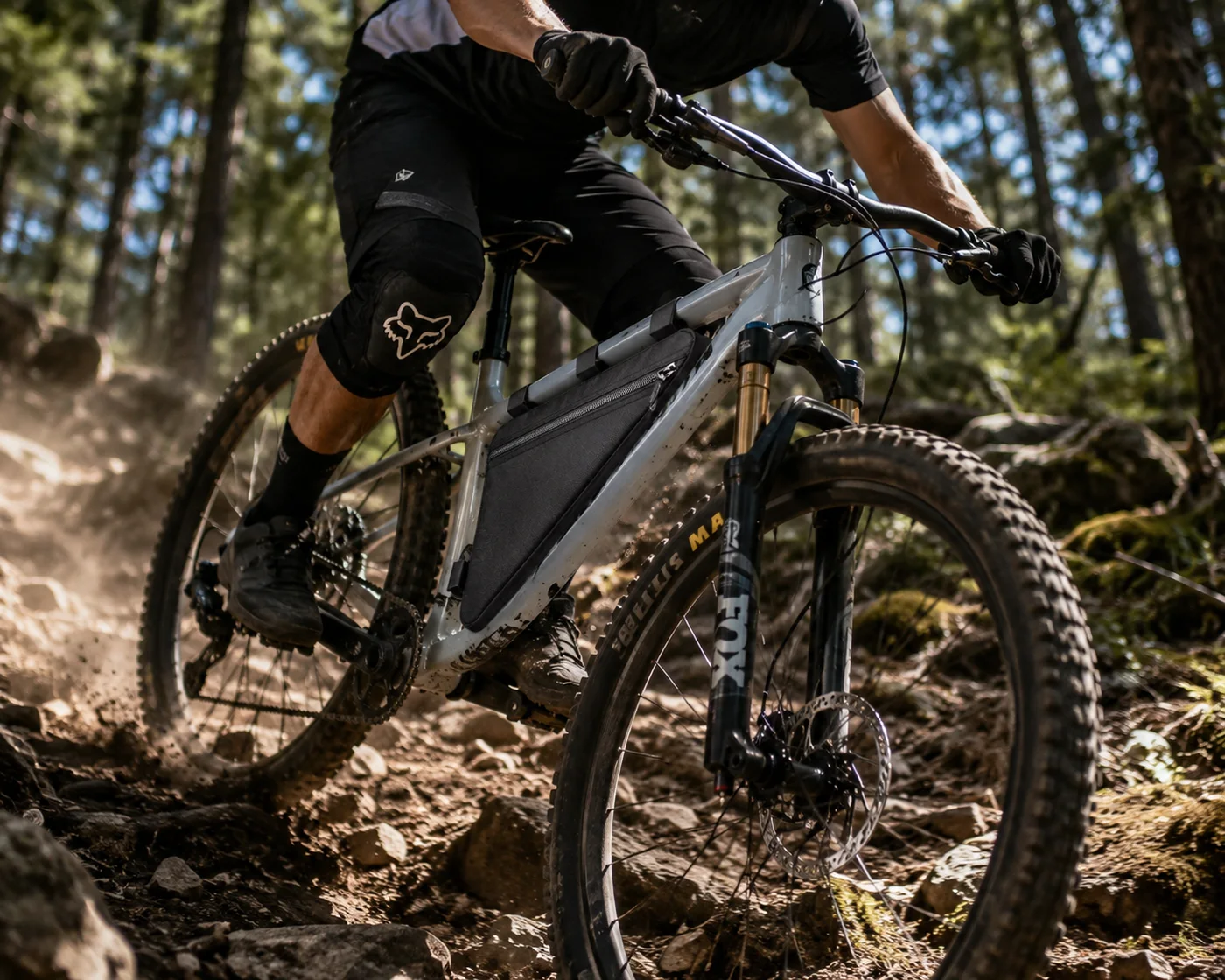
The Ridgeline Trail sits in the one place on the bike that actually helps you: down in the front triangle, tight against the frame. Your tube, multitool, mini pump, snacks, phone and keys ride low and stay put. Nothing sways, nothing sweats against your back, and your shoulders are free to move the bike underneath you. On climbs you're not fighting extra top-heavy weight; on descents the bike stays planted. It's the difference between carrying your gear and wearing it.
Our trail test: what "no rattle" actually takes
We ran the Trail on a hardtail across our usual rough-ground loop — braking bumps, root ladders, rock gardens and a fast fire-road descent — to see what separates a quiet frame bag from a noisy one. The verdict: rattle is almost always a fit-and-packing problem, not a bag problem. Here's what we changed and what it fixed.
| What we tested | Loose / wrong setup | Snug Trail setup |
|---|---|---|
| Strap tension | Slack straps let the bag drift on braking bumps | All 3 velcro straps cinched flat — bag moves with the frame, not against it |
| Packing | Half-empty bag, tools clatter inside | Fill dead space with a rag or snacks so nothing shifts |
| Knee clearance | Bulky pack rubs on standing climbs | Slim profile inside the triangle — knees swing clear out of the saddle |
| Rough-ground noise | Rattle audible over the tires on rock gardens | Silent — you forget it's there, exactly what buyers report |
Field observation from our own ride testing on a hardtail, not a lab spec. Your results depend on frame shape and how you pack.
"On rough trails the two things that matter are where the weight sits and whether it moves. Get the bag low in the triangle and cinch every strap flat, and the rattle disappears — you stop noticing the bag and start noticing the trail."— Marcus Reed, Gear Editor at Ridgeline
Snug fit, knee clearance and staying put on singletrack
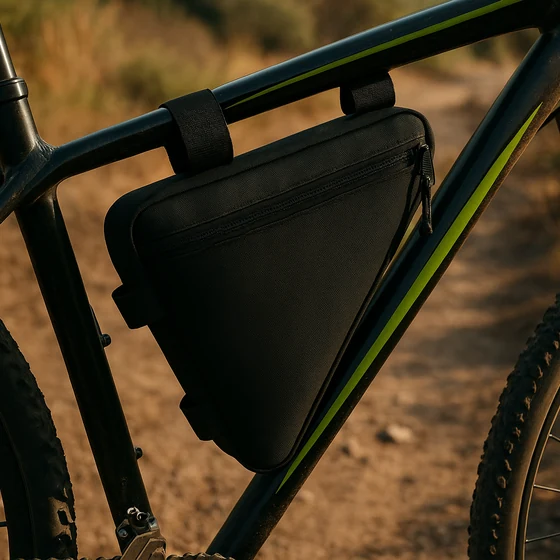
Fit is everything on a mountain bike, because rough ground finds any weakness in your setup. The Trail's velcro straps wrap different tube diameters — road, MTB and gravel frames all work — and cinch down hard so the bag becomes part of the frame rather than a passenger on it. Two straps up top stop it from tipping forward or back; the down-tube strap kills any sideways sway when you're throwing the bike through switchbacks.
Because it lives inside the front triangle and carries a low, slim profile, it stays out of the way of your legs. Riders who stand and grind up steep, chunky climbs — where your knees track closest to the top tube — get clearance the Trail is shaped for. And when the trail points down and gets rough, the low mounting means the bag isn't adding leverage up high where it would make the bike twitchy. It just sits there, quiet, doing its job.
What fits inside for a day on the trails
Think about everything you actually need to fix a flat and finish a ride: tube, tool, pump, a snack for the bonk, phone and keys. The Trail is sized to carry that trail-repair kit and a little more, all in one grab-and-go spot you never have to unpack from a jersey pocket mid-ride. Verified buyers describe "plenty of room for a tube, multitool and snacks" and call it "well made and affordable."
The Oxford/nylon fabric is the same reason it holds up to trail abuse — it takes rubbing against your frame and the odd bush swipe without fraying. It's water-resistant enough for spray and light rain, though for genuine downpours or creek crossings we'd tuck a small dry bag inside. If you want a fully sealed, hard-shell home for your phone up top, pair the Trail with the waterproof Ridgeline Pilot top tube bag — together they cover both the "keep it dry" and "keep it low" jobs.
Free worldwide shipping · Arrives in 6–10 business days · 30-day money-back guarantee
MTB vs road vs bikepacking: which frame bag setup?
| Riding style | Priority | Best pick |
|---|---|---|
| Mountain / trail | Snug fit, no rattle, knee clearance | Ridgeline Trail (this page) |
| Road / gravel | Low profile, light, aero-ish | Road bike frame bag |
| Multi-day / bikepacking | Max capacity in the full triangle | Bikepacking frame bag |
| Phone up top, waterproof | Touchscreen, hard shell | Pilot top tube bag |
The good news for mountain bikers: you're riding at the busiest time in years for the sport. Over 50 million Americans ride a bike each year, US bike sales hit record highs during the 2020 cycling boom, and the trail-worthy gear market has grown right alongside it. A frame bag that stays quiet and out of the way is one of the cheapest upgrades to how a ride actually feels.
The MTB context, by the numbers
Americans ride a bike each year
— Outdoor Industry Association, 2023
US bike sales hit record highs during the 2020 cycling boom
— NPD Group, 2021
E-bikes are among the fastest-growing US cycling categories, outselling electric cars in unit sales
— LEVA, 2023
More riders means more people discovering the same thing on rough ground: where your gear sits changes how your bike handles. A low, centered load in the triangle is a genuine handling advantage, and it costs a fraction of a fancier component upgrade.
What MTB buyers report
We publish real verified-buyer feedback only — no invented reviews. Here's what riders say after taking the Trail onto rough ground.
"Excellent quality! Sits snug in the frame and doesn't rattle on rough ground."
— Verified buyer
"As described, quality is good. Fast shipping, plenty of room for a tube, multitool and snacks."
— Verified buyer
"Great bike bag — good looking, well made and affordable. Perfect for carrying tools and essentials."
— Verified buyer
Verified reviews. See our reviews page for more.
Who wrote this
Marcus Reed · Gear Editor at Ridgeline
Marcus has ridden and tested cycling gear for over a decade across road, gravel and bikepacking. At Ridgeline he pressure-tests every bag on real rides before it goes live — checking fit, weight, weather resistance and how it behaves on rough ground.
Reviewed and updated July 2026. See how we test and our full frame bag guide.
Free worldwide shipping · 30-day money-back guarantee · Secure Stripe checkout
MTB frame bag FAQ
Will an MTB frame bag rattle on rough trails?
Not if it is fitted right. The Ridgeline Trail uses three velcro straps — two on the top tube, one on the down tube — to pull the bag flat against the frame. When it is snug and packed without loose slack, there is nothing to bounce. Verified buyers specifically note it "sits snug in the frame and doesn't rattle on rough ground."
Does a frame bag get in the way of your knees while pedaling?
The Trail sits inside the front triangle, above the bottle-cage zone and behind the head tube, so your knees swing clear of it on the pedal stroke. It carries a slim profile rather than a bulging pack, which is why it works for standing climbs and technical, out-of-the-saddle riding where your legs move the most.
Is the Ridgeline Trail waterproof enough for muddy MTB rides?
The Trail is made from lightweight Oxford/nylon fabric that sheds trail spray and light rain, but we do not claim a sealed IPX rating. For creek crossings, downpours or truly wet conditions, pack a small dry bag inside, or step up to the hard-shell waterproof Ridgeline Pilot for your phone.
Does an MTB frame bag fit full-suspension bikes?
It fits most hardtails and many full-suspension frames, but full-suspension triangles are smaller and shaped by the shock, so measure your open triangle first. The Trail's velcro straps adjust to different tube diameters, so on a tight triangle it simply rides higher in the corner. Riders with the smallest full-suspension frames often pair it with our Pilot top tube bag and split the load between the two.