· Marcus Reed
How to Choose a Bike Frame Bag
A frame bag is one of the cheapest upgrades you can make to a bike, and one of the easiest to get wrong. Buy the wrong size and it rubs your knees or leaves the front wheel; skip water resistance and your phone rides home wet. This guide walks through the six things that actually matter so you order once and get it right.
I test every bag we sell on real rides before it goes live — road, gravel and rough singletrack — so the advice below is what I check on the bike, not what a spec sheet claims. Cycling is having a real moment in the US, which means more bags on the market and more marketing noise to cut through.
Americans ride a bike each year
— Outdoor Industry Association, 2023
US bike sales hit record highs during the cycling boom
— NPD Group, 2021
E-bikes now outsell electric cars in US unit sales
— LEVA, 2023
1. Frame fit and size — measure first
The main triangle on every bike is a different shape. A compact road frame has a short, shallow triangle; a large gravel or MTB frame has a deep, roomy one. Look at where a bag would sit on yours and ask two questions: does it clear my knees on the pedal stroke, and does it leave a gap above the front wheel and around the bottle cage?
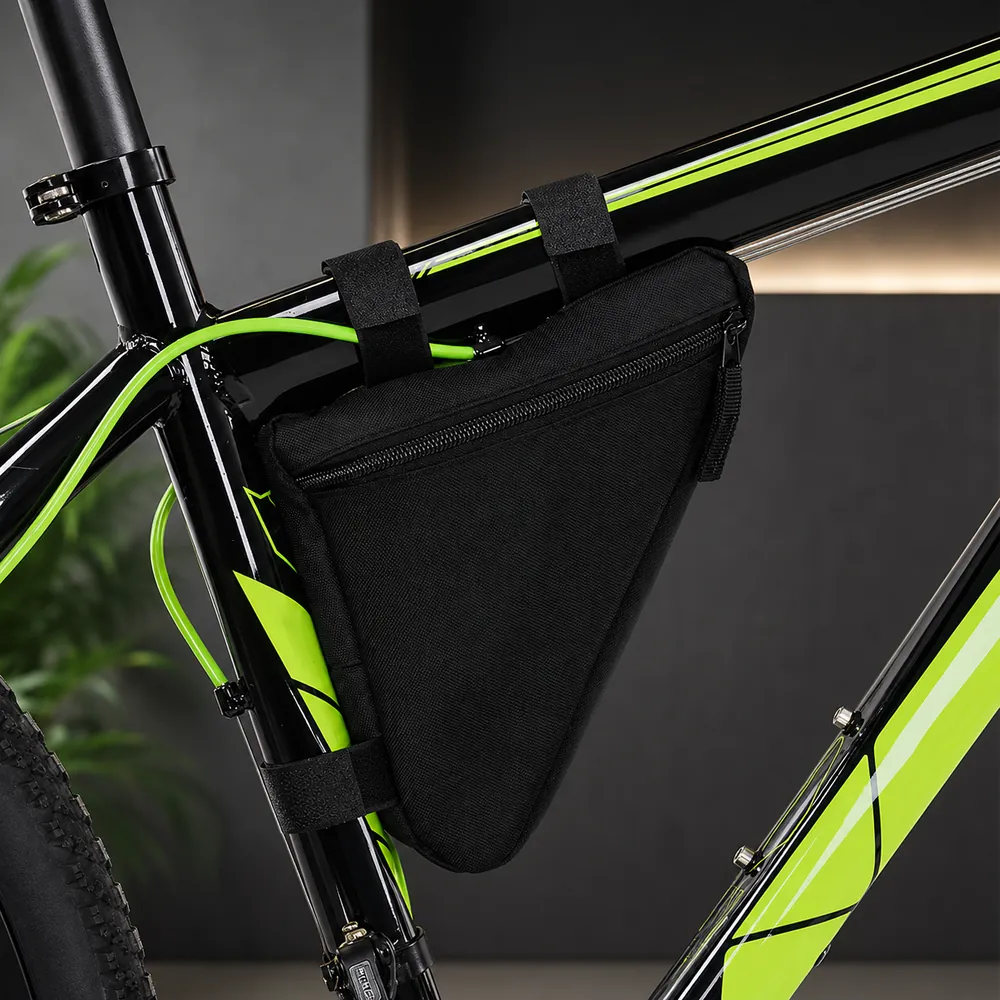
The Ridgeline Trail — Bike Frame Bag is a triangle bag shaped to sit inside the frame and stay out of your pedaling path. It's built to fit road, MTB and gravel frames, but you should still eyeball your own triangle. If you want the exact method — where to hold the tape and what clearance to leave — read our frame bag sizing guide before you order.
One quick shortcut: on compact triangle bags, the shape tells you far more than a liter figure ever will. Judge fit by how the bag sits against your own frame and by the kit it swallows, which is exactly how we size the Trail.
2. Full frame bag vs half frame bag
This is the fork in the road most buyers miss. Here's the trade-off in plain terms:
- Full frame bag — carries the most gear, ideal for long bikepacking days when you're hauling tools, spares, food and layers. The cost is bottle access: you usually lose one or both cage mounts and switch to a hydration pack or bottle elsewhere.
- Half / partial frame bag — sits in the upper triangle and leaves room for a bottle below. Less capacity, but far more practical for commuting, training rides and gravel days where you still want to reach a bottle without stopping. See our full frame bag and MTB frame bag pages for how each style behaves.
The Trail is a compact triangle bag that hugs the top of the frame — it gives you real storage while keeping your cages usable, which is why it suits most riders better than a bulky full bag.
3. Material and water resistance
Fabric bags win on weight and flexibility. The Trail uses a lightweight Oxford/nylon fabric — the kind that shrugs off scuffs and years of knee contact without fraying. A good coated fabric keeps out light rain and the grit thrown up off wet roads, which covers most riding. What it won't do is survive a bucket dumped on it, and we won't pretend otherwise: there's no IPX rating to quote, so we describe it qualitatively.
When you're carrying something that must stay dry — usually a phone — step up to a hard shell. The Ridgeline Pilot — Top Tube Phone Bag is a waterproof hard-shell case with a touchscreen window, so you can navigate and take calls while the phone stays sealed against rain. One verified buyer put it simply: "Impeccable — fits very well on the mountain bike and the phone stays dry." If dry electronics are your priority, see the waterproof bike frame bag options.
4. Mounting — how it attaches to your tubes
Strap-mount bags are the right call for almost everyone because they fit nearly any frame and move between bikes in seconds — no bolts, no bosses required. The Trail attaches with three velcro straps: two around the top tube and one on the down tube. That third point matters. Two straps let a loaded bag pivot; three lock it flat against the frame so it doesn't wobble when the trail gets choppy. A buyer confirmed exactly this: "Excellent quality! Sits snug in the frame and doesn't rattle on rough ground."
Check your tube shape too. Aero or oversized down tubes are wider than round steel tubes, so make sure the straps have enough length to close fully. If a strap can't wrap all the way, the bag will never sit tight. For road-specific fit notes, see our road bike frame bag page.
5. Capacity — carry what you need, no more
Bigger isn't better. The most common mistake I see is buying the largest bag "just in case," then riding around with a half-empty bag that flops on every bump. Size it to your real load. For reference, riders regularly fit the following in the Trail:
- Spare inner tube and a multitool
- A mini pump or CO2 inflator
- Phone, keys and a card or cash
- Snacks or a couple of gels
- Thin gloves or a packable layer
Verified buyers back this up: "As described, quality is good. Fast shipping, plenty of room for a tube, multitool and snacks," and "Perfect for carrying tools and essentials." There's a handling bonus to keeping the load contained in the triangle, too — and it's a real technical fact, not marketing. A frame bag carries weight low and centered in the frame, which keeps your center of gravity low and your steering stable. A backpack rides high on your shoulders and a rear rack loads the tail; the frame bag beats both for balance on descents and loose ground.
6. Cable ports and small details
Cable ports are genuinely useful on long days when you're keeping a phone or GPS topped up from a power bank — the cable stays inside the bag, protected from rain and road grit, while the device charges. If you don't ride that way, don't pay extra for it. It's a feature to want, not a dealbreaker.
A few other small things separate a good bag from a frustrating one: a smooth, snag-free zipper you can work one-handed; a low profile that doesn't foul your knees; and secure internal space so tools don't clatter around. On the Pilot specifically, the standout detail is a touchscreen window that actually works — one buyer noted "the touchscreen window even reads my fingerprint to unlock the phone." That's the kind of detail that decides how a bag feels day to day.
Quick recap — the 6 buying criteria
| Criteria | What to check | Best for |
|---|---|---|
| Frame fit & size | Measure your triangle; clear knees and front wheel | Every rider — do this first |
| Full vs half | Full = max capacity, no bottle; half = bottle access, less room | Half for commuting; full for bikepacking |
| Material & water resistance | Tough Oxford nylon; coated for rain, hard shell for phones | Hard shell if you carry electronics |
| Mounting | Velcro straps that fully wrap your tubes; 3+ points | Any frame, easy bike-to-bike swap |
| Capacity | Size to your real load, not "just in case" | Small for daily; large for overnight |
| Cable ports | Optional pass-through for charging on the move | E-bike and long bikepacking days |
Our recommendation
For most US riders, the sweet spot is a compact, well-strapped triangle bag that carries the essentials and leaves your bottle cages alone. That's the Ridgeline Trail at $29.95. If you also want your phone waterproof and navigable on the top tube, add the Ridgeline Pilot at $24.95 — or grab both together in the Ridgeline Complete Kit at $44.95 and save over the separate prices. Every order ships free with a 30-day money-back guarantee, so you can fit it, load it and ride it before deciding.
Still comparing options? Read real owner feedback on our reviews page, or browse the rest of our guides for fit and packing tips.
Do frame bags fit all bikes?
Most strap-mount frame bags fit road, gravel and mountain bikes because velcro straps wrap around standard tubes. The one thing to confirm is that your triangle is big enough for the bag and that the straps reach around oversized or aero tubes. E-bike tubes run fattest, so check clearance on your specific frame before you order.
Will a frame bag hit my knees?
A correctly sized bag shouldn't. Triangle bags like the Trail are shaped to sit low and narrow inside the frame. If a bag is too tall or too wide for your triangle, your knees can brush it on the pedal stroke — which is exactly why measuring first (see the sizing guide) matters.

Marcus Reed · Gear Editor at Ridgeline
Marcus has ridden and tested cycling gear for over a decade across road, gravel and bikepacking. At Ridgeline he pressure-tests every bag on real rides before it goes live — checking fit, weight, weather resistance and how it behaves on rough ground.